The Growing Opportunity in Cow-Calf Beef Production
Other
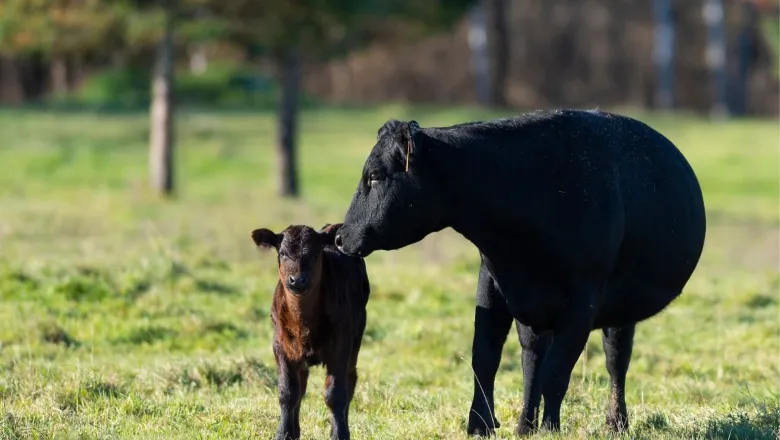
Cow-calf production is the first stage of the beef production process, that spans from the breeding of livestock through the weaning phase. Cow-calf operations mainly maintain a herd of beef cows for raising calves. Most calves are born in spring and weaned at 3 to 7 months. Following the weaning stage, calves can move through the value chain in several different ways. Some of the female calves (heifers) and male calves (bulls) may be retained in the herd or sold to another producer. If additional pasture forage is available at weaning, then some calves may be retained for further grazing and growth until the following spring when the calves would be sold. Throughout the United States, cow-calf operations are located on land that is not typically suited or needed for crop production.
Prefer a printable version? Download the Cow-calf information sheet.
Why cow-calf production?
Beef cow-calf production serves as a highly sought after choice of individuals interested in entering into production agriculture. With several reasons in mind, cow-calf production is a popular choice amongst new agriculturists. Having the ability to start small with less labor and capital investment required, this makes cow-calf operations more attractive to beginning farmers in comparison to other commodity options.
What are the year-to-date pricing trends?
Cattle prices have remained relatively stable since the beginning of 2026. Summer correction has impacted price levels, however, domestic supply of the beef herd remains near record lows. Moving forward the market is anticipated to be rather appealing to beef cattle producers with continued fundamental support with delayed expansion and tight supply.
What are some best management practices?
The following best management practices are supported by research and can contribute to improved cattle health, welfare and operation efficiency.
- Low Stress Cattle Handling: When handling stress is minimized, cattle often show improved immune response, feed intake and productivity. Low-stress handling practices can also improve mothering behavior and positively influence the growth and behavior of future offspring.
- Selection of Breeding Stock: Proper development of beef heifers is an important component of the profitability of a cow-calf operation. It is important to have a proper grasp on genetics and breeding soundness when selecting livestock for your operation.
- Record Keeping: Record calf birth date, sex, and birth weight at calving for use in herd performance improvement programs. Record in the calving records any specific conditions or notes of interest, such as twin births. A cow body condition score and calving ease score can also be easily assigned during calf processing.
- Health Management: Know the signs of a sick calf, including rapid breathing, scours, lowered head and ears, dry muzzle, inside of mouth cold to touch, abnormal posture, etc.
What do the numbers look like for this sector?
- The 2025 calf crop is estimated at 32.9 million head, down about 521,000 head, or 2%, from 2024.
- Operations with 50 or fewer head likely coexist alongside other income streams, or the operations provide supplemental income to off-farm employment.
- Operations with 100 or more beef cows compose 10.5 percent of all beef operations and 60.5 percent of the beef cow inventory.
- The average beef cow herd is about 47 head.
Sources:
https://extension.sdstate.edu/sites/default/files/2021-05/S-0013-02.pdf
https://extension.psu.edu/beef-cow-calf-production
https://www.canr.msu.edu/news/getting_started_with_cow_calf_production
https://www.ers.usda.gov/topics/animal-products/cattle-beef/sector-at-a-glance
https://extension.msstate.edu/publications/beef-cattle-calving-management
https://www.fb.org/intel/markets/smaller-cattle-herd-creates-market-volatility